Category: Tribute


Mutual Response

for the artists Olly & Suzi (& the animals)

Mutual Response (click to hear the poem read – sorry for the gravel in my voice, I’ve just regained it after illness)

First there was a line
grace like the breeze
broken and jagged as the earth
smeared with the essential,
clay tainted with sweat

Hand over hand artistic collaborators
paws and hooves animals imprint
bite, scratch, slither a chaotic contribution
intense encounters in the wilds
artists alongside predators in situ
drawn in charcoal, pigment, sepia,
mud, berries, sap, dye, ochre,
sunder ink, rock ash, and blood

Borneo, Nepal, Alaska, the Galapagos
geography defined by one species
charting the dividing lines
bounded territories a Great Escarpment
bleak prophesy portends tales of
timber wolves and cheetahs on the hunt
sketching bloody prints trailing Namib sands
hostile places leading to an inner seeing

Transfixed by snow swept plateaus
Katmai grizzly bears, Mkomazi blue lions
watercolor turtles swim under painted leviathans
enrapturing Cousteau’s angels
heart of darkness beats in black tiger while
Champa Kali charges down a dusty path
and orcas move through the great silence

Adrenaline’s anaconda twisting around
the shark cage of inspiration we see now
with eyes wide to awe and terror
melt water becomes a roaring stream
impregnating the romance of the landscape
fear’s thunder rumbling through impenetrable forests
ice crystals form within the vigil of deepest knowing
dead fox, oryx skull, and scarlet raven calling
spirit pounds in the chambers of conch shells

the story is the wind
it comes from a far off place
and we feel it
as outlaws demarcate
these lines of extinction

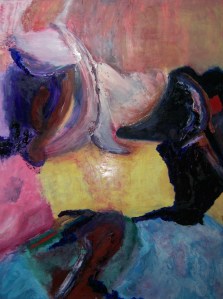
Inner Animal (for Olly & Suzi) 2007 Mixed Media on Paper Anna Montgomery

To find out more about the collaborative artists Olly & Suzi and see their artwork go to http://www.ollysuzi.com/. They have a book out about their work called Artic Desert Ocean Jungle. This poem owes a debt to Joseph Conrad, ‘An empty stream, a great silence, an impenetrable forest.’ from Heart of Darkness & to a San Bushman ‘The story is like the wind, it comes from a far off place, and we feel it.’

Posted for the amazing poetry community dVerse Poets Pub for Open Link Night http://dversepoets.com/2011/10/25/openlinknight-week-15/ come join us!

Inside the Picture

 
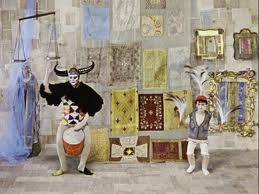
from The Color of Pomegranates

for Sayat Nova and Sergei Parajanov

Before the monastery in Haghbat
prior to the Persian invasion
and death’s black end
that finished my singing

I was the master of song
my love a passion overflowing
the vessel of our lives
birthing poetry

Harmony realized through
creative energy
my beloved books
become the tools of your seduction

Handmade poet’s lyre
turning the inlaid handle
tuning my instrument to your key
each strum upon the body
brings me closer
to the essential

You work the threads of my childhood
Its color and aroma
into the lace of your purity
through you I discover my grace

A gentle wind streams silk
I am the wandering nightingale
burning this white rose for you
water flows over stone
in the Turkish bath of my desire

‘I am careful with your mouth, you speak in fables…’

We players now imbibe love
skipping, drumming, whirling
as we empty our vessels

‘How am I to protect my wax-built castles of love
from the devouring heat of your fires?
You are fire, your dress is fire.
We were searching for a refuge for our love;
instead we found the land of the dead.’

Prodding the lion with a stick
the vultures eye orbs
life’s fragility a globe of glass
tossed in the air, harbinger of
midnight horses and animal hides
antlers and barren branches

Peacock drinks from your lips
muskets fire above your still breast
your death cements my longing
spurs me along the path
lined with stained rubies

The walls of the mausoleum
preserve the tattered ash
of my words
you exist only here, abandoning us
an encaustic imprint
of the dramaturgy of color

Memory shifts the frame of consuming passion
moves me with its rhythm
you wove the lace of death
its visage conceals my pain
your shells upon the black vase

Death obscures your almond eyes
I cannot recognize you
or see my image reflected within

The peacock cries in the window
I will follow you through the black door
though I am cloaked in your colors
I am forbidden to enter now –
blind to the source of my life
I wait for the Persians

‘Who took my mind? I did not see the magician.’

Sayat Nova was an Armenian poet/troubadour (1712-1795) born Harutyun Sayadian in Tiblisi. Sayat Nova means ‘master of song’. His wife, Marmar, died leaving him with their four children. He was killed during the Persian invasion. All quotes are translations of his poetry. Sergei Parajanov was a Soviet Armenian film director. His film The Color of Pomegranates is based on Sayadian’s life. He was banned from making cinema for 15 years following its release for putting aesthetic concerns over ideology.

Linked to dVerse Poets Pub an incredible online poetry community – if you want to join us please click here  http://dversepoets.com/2011/10/18/open-link-night-week-14/

Refusal To Be Cast as the Observed 2008 18X24 Acrylic and Pigment Stick by Anna Montgomery

 for Camille Claudel

Mode de vie

‘Men have expelled you
from the world of symbols…’

born of the culture
knowing eyes ready
to absorb aesthetic influence
caught in gender’s ontological ruse
cast as muse

Le artiste (le future)

‘and yet they have given you names…’

Rodin’s model, mistress
influencer, collaborator
sculptor, painter, a creator
but never equal (non pair)

Le mûr age (fermeture)

‘They say the language you speak
is made up of signs that rightly speaking
designate what men have appropriated.’

poverty and obscurity
now cast out these are
your gifts from society
one that finds no place for
‘a revolt against nature:
a woman genius’
you work, you destroy
anger spirals inward

La fatalité (destinée)

‘They say the language you speak
is made up of words
that are killing you.’

committing you
doctor’s try to convince
Paul to let you out
he refers to you
in the past tense

lying in a communal grave
no one claims you

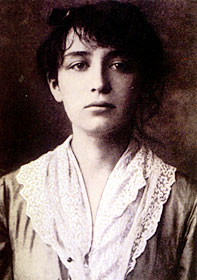
Camille Claudel public domain

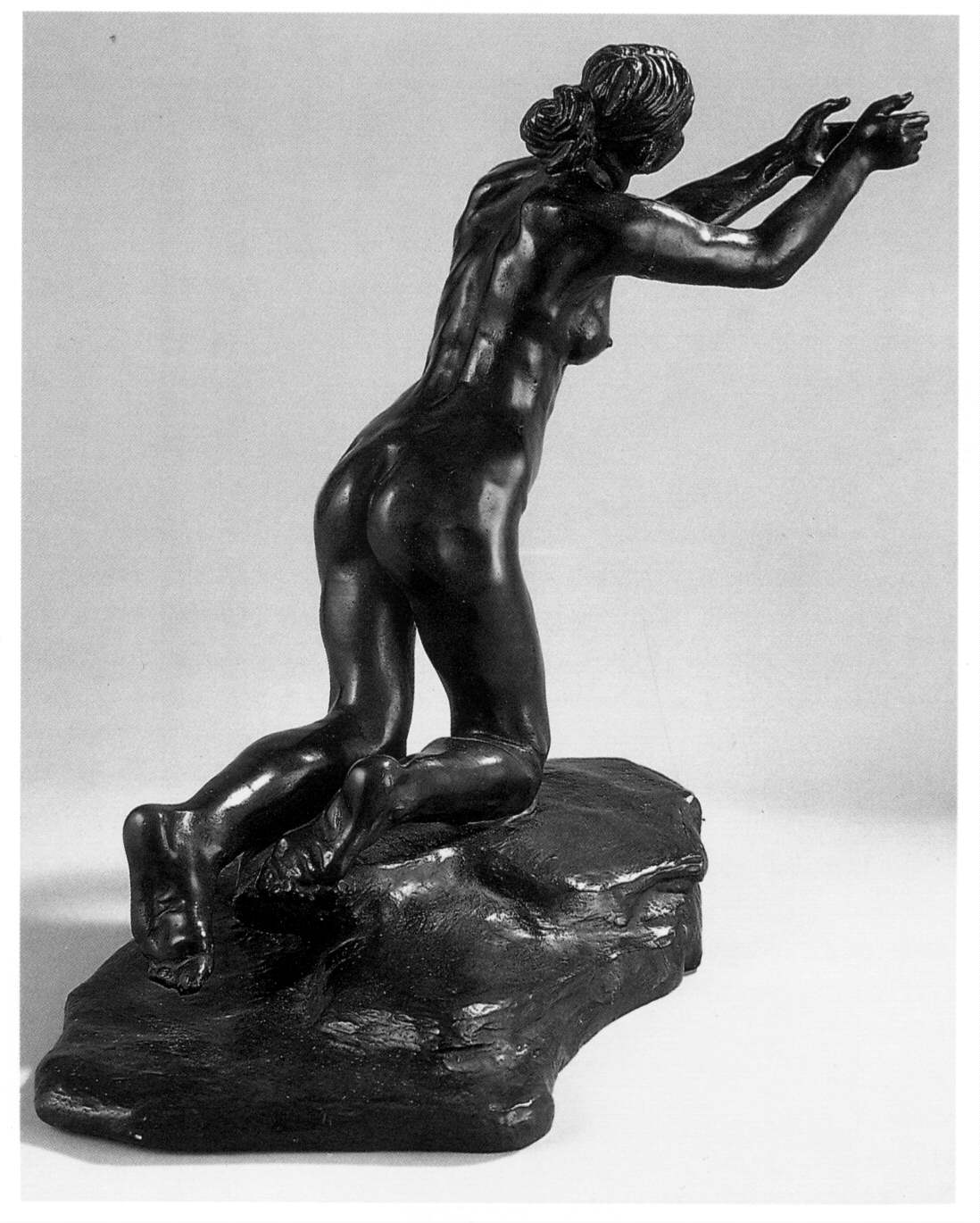
Notes: Camille Claudel was a French sculptor and painter. Art critic Octave Mirbeau called her ‘a revolt against nature: a woman genius’. She was a genius destroyed by the concept of gender and her society. ‘Men have expelled you from the world of symbols and yet they have given you names . . . . They write, of their authority to accord names, that it goes back so far that the origin of language itself may be considered an act of authority emanating from those who dominate . . . they have attached a particular word to an object or a fact . . . . They say the language you speak is made up of words that are killing you. They say the language you speak is made up of signs that rightly speaking designate what men have appropriated.’ is from Les Guerilleres by radical French feminist Monique Wittig. Camille Claudel’s surviving masterpiece which dealt with the dissolution of her relationship with Auguste Rodin was called by several names: The Mature Age; The Destiny; the Way of Life; The Fate. After her break with Rodin she fell into poverty and obscurity. Her younger brother Paul had her wrongfully committed to a mental institution where she eventually died and was buried in a mass grave.

The Emplorer by Camille Claudel

Linked at dVerse Poets Pub for Open Link Night #12 – please join us http://dversepoets.com/2011/10/04/openlinknightweek-12/

he Thea (the Goddess)

for Velvetina Purrs (Thank you)
(this is not a retelling of myth but a new story, a flourish of poetic license)

for a long time now
(yet what are millennia to me?)
I, Athena, have wanted to sing you into being
garnering potency from introspection

the universe is expanding

spinning, weaving, my mantras
into a nascent song
I was born bloodied by the cleaving
fully formed Tritogeneia

the universe is expanding at an ever increasing rate

Metis, root of my strategic mind
my gifts of freedom raise civilizations
Atrytone, the unwearying, dianoia
as a long period comet reaches its aphelion

theou noesis (mind of god)

for a long time now
I have gathered the necessary cistrons
laid them before the axis from where
all beginnings arise at the base of my olive tree

Athena Parthénos in my aspect

I culled the Arctic Ocean, searched my Carina Nebula,
ground Himalayan salt, rang Buddhist bells,
bound pterodactyl wing bones with wolf fur
faceted padparadscha sapphires and stole Ayres’ Hinba
to merge with my vast dark within

parthenogenesis: incanting the ritual mysteries of your birth

daughter arise!
the first to fashion yourself
blue fire hair, Boulder opal eyes, glaukopis
art’s child, you see through iridescent irises

Nova Aetas

speaking you shift what is known, what is knowable
oh, olive branch, each leaf bearing my name
Athena Hygieial, healer
Aphaea, an invisibly numinous being
Altheonóa, ethonoe, en ethei noesin

defender of moral sagacity, flawless virtue,
a cunning intelligence, owl-woman reclaimed
your flight is a miracle of liberty!

clavis aurea, golden key to the future

Whistler (Bird Woman)

Linked to dVerse Sestina challenge http://dversepoets.com/2011/09/22/formforall-sestina-and-its-variations/

Torn, Anna Motngomery, Painting, Chromaphilia, Chromapoesy

Torn Anna Montgomery 2011 Oil on Board

(Dedicated to A.S. Byatt, all quotes are from her lips or her books, some of the poem comes from an Artist Statement I wrote for a solo show in 2005)

Whistler (click to hear the poem read)

Her ‘greatest terror which is simply domesticity’ with its denial of liberty
Struggling with feminism: ‘their language, like their bodies, was a dreadful hybrid’
Tyranny was a death sentence, via lethal injection, to her volition
For one who’s ‘passionately interested in language’, her display monumentally erudite
An engagement in the broader world, in an expansive psyche
Within her I recognize genius, incandescent purpose, need, here is my encomia

Prizes line up to offer formal encomia
Each reinforcing and elaborating her intellectual liberty
‘I like to write about people who think, to whom thinking is as important and exciting (and painful) as sex or eating’ in full embrace of psyche
Admitting ‘writing is always so dangerous. It’s very destructive.’ a paradoxical hybrid
A concatenation of zoology, myth, dystopia, psychology, art, politics, ethics truly erudite
Displaying all the passions of mind within her volition

‘She would give anything for a child and had duly given birth to a monster’, this volition
A half-hedgehog half-boy, an ugly creature, hardly her desired encomia
Whom she fed just the same, coddled, and loved for his mind, agile and erudite
Suckling on, then weaned, speaking the half-breed language of liberty
Embracing his role as an evolutionary hybrid
Evolving, Eros to Psyche

‘Structures of authority, of persecution, of hierarchy’ excised from the psyche
All these things ‘which led to oppression’ in a great caving of volition
Were cast aside, power a twisted, engineered hybrid
He’s ‘a naturally pessimistic animal’ leery of encomia
Who set out into the world to define his liberty
Circumnavigating, investigating, experiencing all distilled to become more erudite

Encountering Whistlers, bird women, their ‘feather words and skin words grown into each other’ his sight is erudite
Singing and whistling in a cacophony emitting from the dual psyche
They had been banished, pariah, for their desire and seizing of liberty
Each act of will now a strained volition
‘We wanted the speed and danger of the wind’ the Artic Tern sang our encomia
Twinning dualities longing to be whole or at least embrace multiplicity, no vile hybrid

I hear this echo in in my painting language, a hybrid
Where I spin ambiguity and chaos in a sphere of erudite
Possibilities, pluralism, and paradox not garnering encomia
But pain, confusion, a language unclear, but of the psyche
Birthed from my own volition
An unshackled liberty

Encomium is not a purpose for art, it is a bastard hybrid
Liberty oppressed to the sick purpose of an erudite
Psyche that panders to ambition’s deadly volition

Witnesses


Mnemosyne, grandmother,
whose many names
are older than memory itself
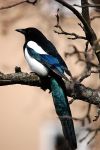
enfolds herself within a Magpie spirit cloak
and spins forth a world where her
Muses bear daughters

She flies from her home
where I am forbidden to travel
Blue Lake upon Taos Mountain
through the Pueblo at the mouth
of Red Willow Canyon

Calling her two eldest granddaughters to her side,
a pilgrimage to Conifer Mountain
three Horarctic Magpies
hudsonia here in the Rockies
forage in the blue-eyed grass
walking along the grey fox-trod path
pat down by elk hooves

Good morning Grandmother, I am singing today

Juniper bush patches
quilted with kinnikinnick
orange paintbrushes dotted with
columbines rise above
toadstools and ferns
black bear stalks the wood pile

She begins to mend what is
broken but her own
we are broken but her own

They’ve never come this far
this high upon the mountain
alpine yarrow beneath the
ever changing light, a forest of aspens,
blue spruce, and bristlecone pines
she nurtures and connects
intimating a heroic form to life

Magpies are inventors via
expansive executive function
insightful passerines
‘catch me if you can’ tricksters
who create their own tools
to dig up the truth

Black beak burrows damp earth
Grandmother is making cache holes
while aspen eyes keep watch
she buries a writing tablet,
aulos, veil, dual faced masks
scrolls, cithara, globe, and compass
flashes her eye grounding memory
leaves her true gifts and looks me in the eye

Grandmother your granddaughters are waiting for the time of unearthing

The three begin to
sing one another’s songs
preparing to fly home for
Magpies, like their sisters Ravens,
recognize themselves in the mirror

Posted at dVerse for Open Link Night http://dversepoets.com/
Sesquipedalianism and Logophilia Engage in Logomachy click to listen to the author read this monster
Sesquipedalianism and Logophilia Engage in Logomachy click here for the PDF which has original Word footnote formatting

Sesquipedalianism (1) and Logophilia (2) Engage in Logomachy (3)

(The definitive annotated version (forgive the parantheses but even HTML couldn’t copy the format of MS Word’s annotation) which is dedicated to Arron Shilling who laughed when I sent it to him)

ATTENTION: The part of Logophilia, written as an avatar for Arron will be played tonight by Anna (on the recording) because, well, she looks better in a dress (wait, didn’t you say on the recording?) – also, she will have to play the part of Sesquipedalianism since she couldn’t find a pompous ass to pull it off – however, stay tuned kiddies because at some point in the future Arron and Anna will role out a poetic/philosophical dialectic (4) complete with Thesis, Antithesis, and dueling Syntheses (5) which we both promise to keep short). Now without further interruption the poem begins:

Sesquipedalianism, a mathematician in his prime (6),
frets on his way to the 1.0 X 10⁻⁶ society (7) for
the infinitesimally small number of people
with über IQs, born without a sense of irony (8)

Once there he converses with the child prodigy
pontificating on the demerits of ochlocracy (9) and Fourier (10)
f(x)=a_0+∑_(n=1)^∞▒(a_n cos⁡〖nπx/L〗+b_n sin⁡〖nπx/L〗 ) (11)
Eigen solutions (12), elementary really

Then she walks in the side door
Logophilia (13), dressed to the nines
snickering in a daring act of trespass
cutting through to the alley leading
to Eudaimonia (14), the philosopher’s club next door
notorious for attracting Sappho (15) wannabees

she pauses to overhear the conversation
Sesquipedalianism is sententiously (16) spouting in the hall
“Poesy (17) as noted by literati (18) is in the antechamber (19) of expiry (20)
all the better for us” he concludes with an air of superciliousness (21)
“Poetry isn’t dead! Why just yesterday I said:
In noumenon dominion shakes
Roquentin’s nauseated theme park,
the fugitive melody – Seeping
the external drift (22)”
and so the verbal barrage continues, each
point and counterpoint escalating their logomachy (23)

as the altercation reaches a fevered pitch
Logophilia howls the club needs a higher ceiling (24)
at which point it would later be generally remarked
she took it to the mattresses (25)

Now no self-respecting pedant (26) could bear the dishonor
especially within the hallowed halls of his own club
“‘Le coup de Jarnac’ (27) won’t save you now missy
Choose your second! I choose Evariste Galois (28)”

This ain’t no ‘petticoat duel’ (29)
I don’t need a second; I was trained by Carlos Hathcock (30)
our words will manifest our weapons
upon the field of honor

Sesquipedalianism confident agrees
he shows up early to practice shots
his abstruse words conjure up
an English Flintlock Blunderbuss (31)
flared at the end, a gilded dragon thunder pipe
powder box and all
that misfires and kills his second

on the next practice shot he focuses
remembering he hung the ‘ten of diamonds’ (32)
surely he can kill a girl
and hits a bystander square in the jaw
Harry Wittington (33) winces
reloading he never makes
that third practice shot

Logophilia miles away
incants her power phrase
conjuring a .5MOA (34) 50 caliber
5000 meter range
Precision Sniper Rifle
calculates the range, wind direction,
wind velocity, air density, and elevation
with a single shot
pierces Sesquipedalianism’s brain stem

She says now kiddies remember:
‘Talent hits a target no one else can hit;
Genius hits a target no one else can see’ (35)

Or I could have avoided this confounding,
annotated, curious, satirical and long winded tale
and simply said:
Logophilia shoots Sesquipedalianism dead!
or alternately poetry beats pedantry
(or even simpler as Brian @dVerse
already knows, ‘love wins!’;)

(but where’s the fun in that?)

1 Sesquipedalian language uses long and obscure words when shorter, everyday words would be more effective. From Instant Word Power by Norman Lewis ©1981
2 Logophile: A lover of words. Shorter Oxford English Dictionary Sixth Edition ©2007 Logophilia: Goddess of the love of words, i.e. a damn fine lover
3 Logomachy: contention over words
4 Dialectic: originally Socratic philosophical discourse or style of inquiry based on critical examination
5 Developed by Hegel as dynamic process based on Socratic dialectic Word Menu ©1992
6 ‘prime’ a mathematical joke and play on words, ding!
7 1.0 X 10-6 = 99.9999th percentile IQ society called the Mega Society, they look down on the Promethean Society and way down on Mensa
8 Oxymoron alert: these are people who are too dumb to question the validity of or ponder the original purpose of IQ tests and the pseudoscience it lent credibility to, namely eugenics, high IQ but not gifted, narrow-minded smart people
9 Ochlocracy is mob rule!
10 Jean Baptiste Joseph Fourier: French mathematician (1768-1830)
11 Fourier Series – a formula Microsoft Word can insert in the text but which WordPress has mangled beyond recognition 😦
12 Small mammalian frogs (really?) no but do you know what it is, I mean really know? Wiki says any of the results of the calculation of eigenvalues
13 See footnote #2.
14 Eudaimonia: concept in virtue ethics that translates to happiness or flourishing but contingent on ethical imperatives. The concept of eudaimonia, a key term in ancient Greek moral philosophy, is central to any modern neo-Aristotelian virtue ethics and usually employed even by virtue ethicists who deliberately divorce themselves from Aristotle. It is standardly translated as “happiness” or “flourishing” and occasionally as “well-being.”
Each translation has its disadvantages. The trouble with “flourishing” is that animals and even plants can flourish but eudaimonia is possibly only for rational beings. The trouble with “happiness”, on any contemporary understanding of it uninfluenced by classically trained writers, is that it connotes something which is subjectively determined. It is for me, not for you, to pronounce on whether I am happy, or on whether my life, as a whole, has been a happy one, for, barring, perhaps, advanced cases of self-deception and the suppression of unconscious misery, if I think I am happy then I am — it is not something I can be wrong about. Contrast my being healthy or flourishing. Here we have no difficulty in recognizing that I might think I was healthy, either physically or psychologically, or think that I was flourishing and just be plain wrong. In this respect, “flourishing” is a better translation than “happiness”. It is all too easy for me to be mistaken about whether or not my life is eudaimon (the adjective from eudaimonia) not simply because it is easy to deceive oneself, but because it is easy to have a mistaken conception of eudaimonia, or of what it is to live well as a human being, believing it to consist largely in physical pleasure or luxury for example.
The claim that this is, straightforwardly, a mistaken conception, reveals the point that eudaimonia is, avowedly, a moralized, or “value-laden” concept of happiness, something like “true” or “real” happiness or “the sort of happiness worth seeking or having.” It is thereby the sort of concept about which there can be substantial disagreement between people with different views about human life that cannot be resolved by appeal to some external standard on which, despite their different views, the parties to the disagreement concur.
All standard versions of virtue ethics agree that living a life in accordance with virtue is necessary for eudaimonia. This supreme good is not conceived of as an independently defined state or life (made up of, say, a list of non-moral goods that does not include virtuous activity) which possession and exercise of the virtues might be thought to promote. It is, within virtue ethics, already conceived of as something of which virtue is at least partially constitutive. Thereby virtue ethicists claim that a human life devoted to physical pleasure or the acquisition of wealth is not eudaimon, but a wasted life, and also accept that they cannot produce a knock down argument for this claim proceeding from premises that the happy hedonist would acknowledge.
But although all standard versions of virtue ethics insist on that conceptual link between virtue and eudaimonia, further links are matters of dispute and generate different versions. For Aristotle, virtue is necessary but not sufficient —what is also needed are external goods which are a matter of luck. For Plato, and the Stoics, it is both (Annas 1993), and modern versions of virtue ethics disagree further about the link between eudaimonia and what gives a character trait the status of being a virtue. Given the shared virtue ethical premise that “the good life is the virtuous life” we have so far three distinguishable views about what makes a character trait a virtue.
According to eudaimonism, the good life is the eudaimon life, and the virtues are what enable a human being to be eudaimon because the virtues just are those character traits that benefit their possessor in that way, barring bad luck. So there is a link between eudaimonia and what confers virtue status on a character trait. But according to pluralism, there is no such tight link. The good life is the morally meritorious life, the morally meritorious life is one that is responsive to the demands of the world (on a suitably moralized understanding of “the demands of the world” and is thereby the virtuous life because the virtues just are those character traits in virtue of which their possessor is thus responsive (Swanton 2003). And according to perfectionism or “naturalism”, the good life is the life characteristically lived by someone who is good qua human being, and the virtues enable their possessor to live such a life because the virtues just are those character traits that make their possessor good qua human being (an excellent specimen of her kind). Stanford Online Dictionary of Philosophy If you actually read this footnote it is quite possible you are living a eudaimon life or maybe have too much free time. This is the reward you’ve gained (sorry no extra credit). If you didn’t read this entire footnote then you won’t know we’re calling you names like Fred, lazy, or solipsist behind your back.
15 Sappho ( /ˈsæfoʊ/; Attic Greek Σαπφώ [sapːʰɔː], Aeolic Greek Ψάπφω [psapːʰɔː]) was an Ancient Greek poet, born on the island of Lesbos. Later Greeks included her in the list of nine lyric poets. Her birth was sometime between 630 and 612 BC, and it is said that she died around 570 BC, but little is known for certain about her life. The bulk of her poetry, which was well-known and greatly admired throughout antiquity, has been lost, but her immense reputation has endured through surviving fragments. Or so says Wikipedia. @expoetics joshuA says: On Sappho […] born of eros[ion…] resin and ruin […] who is what Time did to her […] the fragment suggests […] ineffable who[le…] ©2011 vandalized today
16 Sententiously – delivered in a pompous or moralizing manner – like this poem
17 Poesy: poetry darlings
18 Literati: fancy people, not you or me, who read the right books and discuss them, they hang with the intelligentsia, also now a variant of Scrabble™
19 Antechamber: vestibule
20 Expiry – a frilly way to say death
21 Superciliousness: feeling or displaying haughty disdain says the free dictionary (free source=questionable data?)
22 From Arron Shilling’s excellent Atomic Charade to which I commented, “I have not read Sartre’s Nausea but now I am intrigued and must do so. Antoine Roquentin is liberated, as I understand it, to engage in creating his own meaning in the world. A real existential crisis is apparent in this work. These lines feel seared into your being (sorry if the narrator is not you but a fictitious ‘I’ for effect) perhaps the Atomic Charade of the title. The cognitive dissonance is at a frenetic pace here: if the resurrection is fallacy, is entropy the only legacy of life? Where is integrity at the atomic level, ethical action birthed, when all you’re left with is emetic phenomenological concerns? Is Kant’s neumenal world real just completely unknowable or are we left with no beyond the knowable? You’ve certainly sparked the desire to reread and read new philosophical arguments. Your poem is finely wrought, heartbreaking, and it seeps all the way to the quarks.” You see how I am qualified to write the part of Sesquipedalianism ;).
23 Summation because this poem is long enough as it is without adding pages of dialogue, you’ll be happier I didn’t in the end
24 IQ tests have ceilings, the higher the ceiling the greater its ability to discern the upper echelons of intelligence. Presumably the society club they fight in would have the highest ceiling (ha! though maybe you don’t enjoy jokes that have to be explained)
25 “Take it to the mattresses” Godfather © 1972 During mafia wars it isn’t safe to sleep at home.
26 I’m getting tired of these notes! You’re getting tired think of the poor reader. Pedant: noun 1. a person who makes an excessive or inappropriate display of learning. 2. a person who overemphasizes rules or minor details. 3. a person who adheres rigidly to book knowledge without regard to common sense. 4. Obsolete . a schoolmaster. Sayeth dictionary.com
27 ‘Le coup de Jarnac’ a legend arising from a French duel that lead people to believe there was a move an amateur swordsman could pull on a master to win.
28 Evariste Galois a mathematician who, at 20, died in a duel under suspicious circumstances!
29 The Petticoat Duel was fought 1792: Lady Almeria Braddock versus Mrs. Elphinstone – don’t believe me then look it up – them bitches took it to the mat!
30 Carlos Hathcock trained snipers at the Marine Corps Scout Sniper School in Quantico after distinguished service in Vietnam.
31 England 18th Century; a blunderbuss is a muzzle-loading firearm with a flared, trumpet-like barrel and is the predecessor to the shotgun; known for its inaccuracy.
32 ‘ten of diamonds’ is the nickname given to the VP of Iraq Taha Yassin Ramadan who was hanged for his crimes. In 2002 he suggested that President George W. Bush and Saddam Hussein resolve their differences though a duel
33 Harry Wittington was shot in the face by Vice President Dick Cheney in 2006 (no, I am not making this up)
34 MOA = minute of angle
35 Arthur Schopenhauer (Who? Oh, go read a book.)

Casting Hollow Precipices

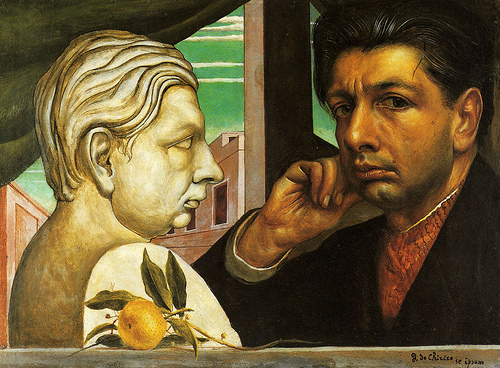
He nevertheless produced backdated “self-forgeries” both to profit from his earlier success, and as an act of revenge—retribution for the critical preference for his early work.

This is a post for the dVerse prompt on artist Giorgio de Chirico.

Casting Hollow Precipices (click to read the poem read)

Querulous forming bodies gesticulating
specious melancholy turns flickering ivy wilting bowers
casting hollow precipices of venial autophagy

jumping lascivious shelters along tantalizing downspouts
while frivolity and hope cavort
illuminated by broken serrated wine gardens

licking poisonous frills up vestments
of nouns arborous consuming limitless
Prussian blue snuffers frothing magnanimity

sliding deconstructed zoological gathers
while populating quips radiating aspect ratios
lined parallax of jinxes or bemoaning victorious

tumbled traits unconscious on smothered nauseous florid grandiosity
bailing sensitive assurances with galloping crowns gilded
hampering flotillas of bawdy helium didactic formal art perched

dying in vitriolic plumes of xeric tomes unending

Ode to the Gardener – click here to hear the poem read

Opalescent tendrils of vascular bundles
transmitting ecstatic affiance to a
hypanthia of fractals reaching

the garden’s frontis piece
quincunxial arrangement
with Syrinx at the center

she presides at the gate
reeds echoing melismas
of verdant overtures poetic

past nymphs in fits of paraesthesia
pounding sepals, petals, stamens, osculant
while a hawser binds leeward vessels tightly

fleeing from Pan’s wild and ferruginous lust
the nectary sustains a comminuted fracture
Bohdi tree’s enlightening sap releasing

it is a mandala ever spinning
universe’s ontology round
a radiant funiculus
a bliss eternal

Dedicated to Joy (Hedgewitch)